A $75 printer and a very long to-do list
From face shields in 2020 to mind-controlled prosthetic arms, high schoolers with hobbyist hardware keep doing work that used to need a lab.
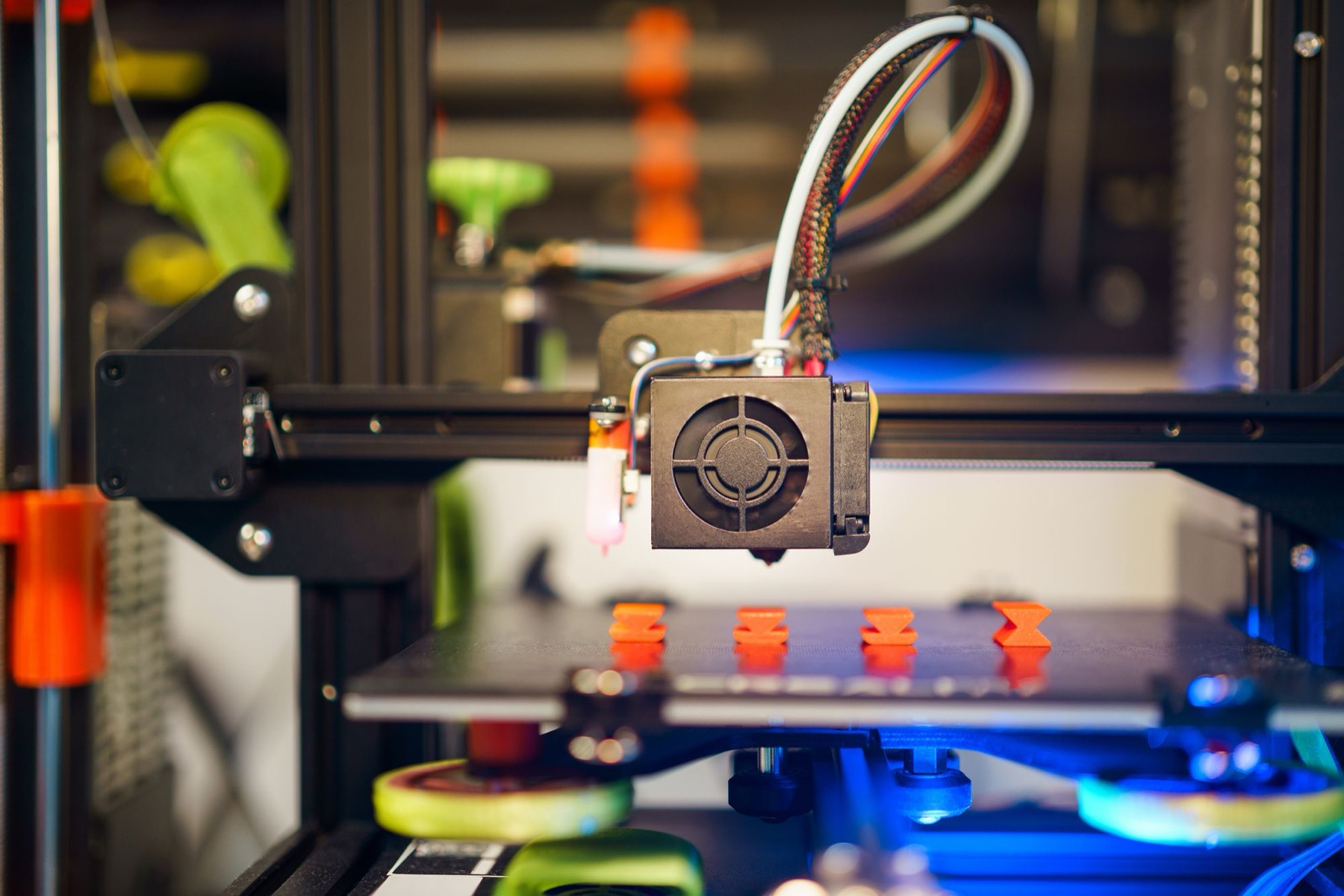
In the spring of 2020, the world ran out of face shields, and a surprising number of people who happened to own a 3D printer turned out to be in high school.
Hospitals wanted protective gear. Schools had gone dark. Somewhere in between, a loose network of high school students looked at the printers gathering dust in their robotics rooms and bedrooms and decided that was a supply chain.
The shield years
Start in Camdenton, Missouri. Zane Foulk, a senior at Camdenton High School and a member of a local youth robotics team, helped turn printers borrowed from a nearby middle school into a shield factory. VOA Learning English reported that the project began with a local hospital’s request for 150 shields and grew to hundreds. “We have been making roughly 40 face shields a day,” Foulk said. The first donated shields went to Lake Regional Hospital. VOA also found Will Olsen, a 17-year-old junior in Kensington, Maryland, who helped deliver printed parts.
In Andover, Massachusetts, the operation had a cash flow problem and a solution involving T-shirts. Pratheek Kuimanda, a junior at Andover High School, led a team of seven classmates. The Boston Globe reported that they had made about 200 shields and wanted at least 400. A $500 grant from the Service Club of Andover helped, and the Globe said the $25 T-shirts funded roughly 10 to 12 shields. At first a single shield took four to five hours to print. Neighborhood families pitched in. “That helped us scale up our efficiency pretty well,” Kuimanda told the Globe. The shields went to Massachusetts General Hospital and Lawrence General Hospital.
The pattern was not American. In Kinsale, West Cork, Oisin Coyle, a fifth-year student, and Shane Collins, a Transition Year student, were printing shields at Kinsale Community School. The Irish Examiner reported on 1 April 2020 that about 63 or 64 had been made, with a target of 100 the next day. The school’s principal, Fergal McCarthy, said the design came from online and had been approved by local doctors, which is the kind of quality control that makes a hospital say yes.
The slower, harder kind of building
PPE was an emergency, and emergencies end. Prosthetics do not have the same decency. Some teenagers took the printer and aimed it at a problem with a longer shelf life.
Benjamin Choi, a 17-year-old senior at the Potomac School in Virginia, built a prosthetic arm that reads brain waves. Smithsonian Magazine reported that he started during the pandemic in 2020, in his basement, printing on his sister’s $75 3D printer. The arm uses a forehead sensor that sends brain-wave data over Bluetooth to a chip in the arm, where an AI model interprets it. It also responds to head gestures, and an intentional blink stops it. Smithsonian put the cost to make it at about $300, against about $7,000 for a basic body-powered prosthesis.
The design went through more than 75 iterations, which is the polite way of saying a lot of arms did not work. Choi was a Top 40 finalist in the 2022 Regeneron Science Talent Search, according to the magazine.
The most ambitious teenage hardware project in this roundup may also be the least glamorous in its origin story, because it started with being annoyed at a price tag. In North Macedonia, a team of high school students called eBionics built a 3D-printed bionic arm that uses muscle sensors to read signals from the forearm. In a UNICEF North Macedonia interview published in July 2020, the team said they were “outraged by the unnecessarily high prices of bionic arms existing on the market.”
The team’s own claim is that the arm is at least 28 times cheaper than bionic arms currently on the market. UNICEF presented that as the team’s figure, not an independent finding, and so do we. The students credit the savings to free downloadable 3D-printing models and to skipping delivery charges and manufacturer profit margins. Orhan, Teo, Anamaria and Boris split the work between design, programming, social media and a website. It took about five months, and the team won the local round of the Generation Unlimited Youth Challenge and was one of two teams chosen to represent North Macedonia in the global round.
What the pattern says
Look across these stories and the hardware is almost beside the point. None of these stories started with a lab. They had a cheap printer, a deadline set by somebody else’s emergency, and a habit of treating a published design as a starting point rather than a finished answer.
The cost comparisons are worth a skeptical read, since a prototype is not a product and a $300 arm has not been through what a clinical device must survive. But a model that a teenager can iterate 75 times in a basement is a different kind of pressure on an expensive market than a white paper.
It is also worth noting how unpretentious the fixes are. A T-shirt sale. A borrowed middle school printer. A neighbor who offered a machine. None of it required permission from anyone who was not already helping.
The printers are still out there, and presumably so are the teenagers.